Despite challenging economic conditions, new housing, retail and trade development projects continue to progress across the UK.
 Adam Trevaskis, Business Development Manager, Fusion Utilities
Each of these new developments will require a permanent, safe and reliable supply of electricity to each building within it.
Increasingly, this requirement demands the installation of a dedicated 11kv package substation to draw power from the grid, convert it from high to low voltage, and then transport it to the point of use.
High-voltage electrical installation is very specialist work and will require a trained professional to ensure the installation is safe and compliant with the ENA Engineering recommendation G81 framework.
Meanwhile, for safety reasons, substation components cannot be left exposed to the elements either before or during installation, meaning bases and housing must be in situ in a timely manner.
The three main elements of any package substation are the ring main unit, which connects to the incoming HV cable; the transformer, which converts to the high-voltage electricity to low voltage power suitable and safe for domestic and business use; and the low-voltage cabinet, which has connectors directing power to each building to be supplied.
In the main, there are only a handful of companies who manufacture compliant ring main units and low-voltage cabinets. This can create significantly longer lead times which can only be overcome by proactively holding stock of the most commonly needed items.
Purchasers also need to be sure of which size of product they will need. Transformers come in 315, 500, 800, 1000 or 1500 KVA depending on the scale of the site and number of buildings to be served. Meanwhile, low-voltage cabinets are available in sizes ranging from 800-1600A and up to seven ‘ways’ – the connection to each building.
A further challenge emanates from the differing requirements of each of the regional distributor network operators (DNOs) when it comes to substation specification. It is vital for the contractor to know which DNO’s regulations apply on the site and to source accordingly.
While it is possible to order each component direct from the manufacturer, lead times vary – as much as 24 weeks in some cases – and this manner of procurement has not always proven to be the most reliable.
The combination of issues surrounding safety, compliance and timely availability means there is much value to be gained from considering better ways of meeting substation requirements.
Many of the leading merchants have forged strong partnerships with the manufacturers of substation components and hold many key components in stock. In the rare event that a required component is not available from stock, they can use their buying power to source it rapidly.
This capability to source and deliver crucial substation components and ancillaries as a package has already delivered significant financial and logistical benefits to multiple customers
Some have taken this a step further and have the ability to supply a ‘package substation’, based on the specification provided by the customer. Comprising all of the required components connected together, this is delivered to site as a single unit and so can result in substantial savings for the contractor, when compared with the cost of finding a specialist to connect them.
A further benefit of this approach to substation delivery is that the merchant can supply essential ancillary items such as ready-cured substation bases, GRP housing, earthing materials, cables, terminations, warning labels, PPE, site-specific engraved labels, jointing materials and ducting. In addition, the merchant can support contractors with hire options for critical equipment such as cable drum trailers and winches, reducing the need to coordinate multiple suppliers.
A robust base is a prerequisite for a successful installation, but if a customer undertakes a base installation themselves, this can require a curing period of up to 28 days, impacting on already tight project schedules and deadlines. By contrast, a pre-supplied, ready-cured base takes as little as three hours to install and can be used immediately.
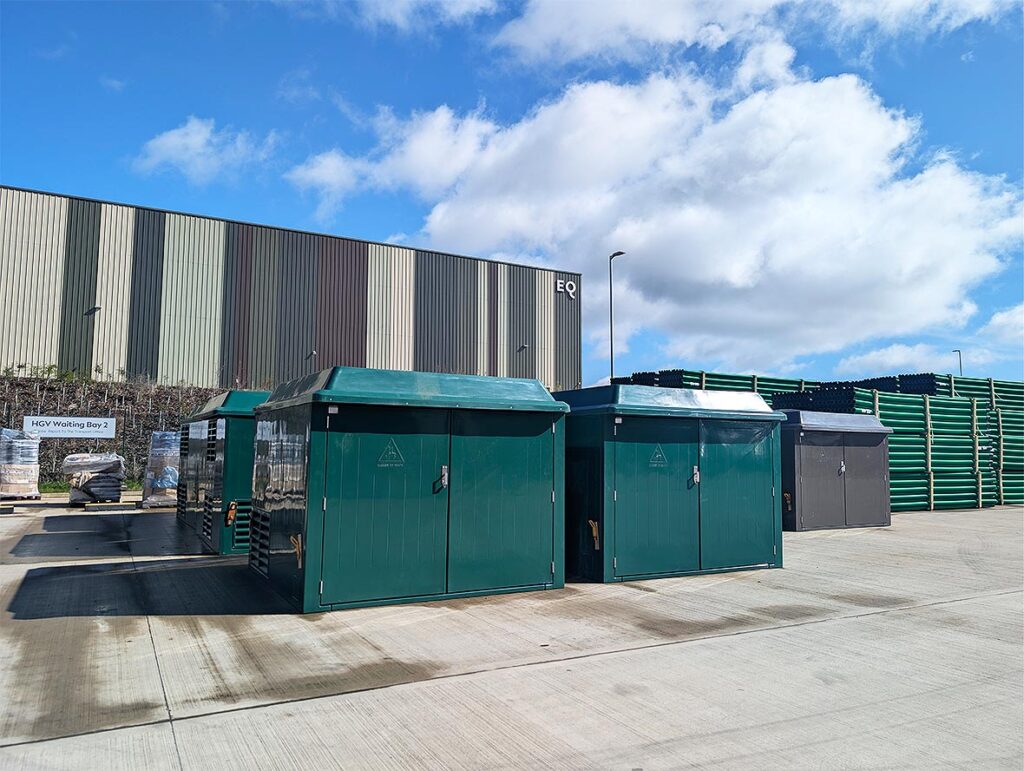
Meanwhile, GRP housings, which come in a variety of sizes and colours, are vital to protect the key substation components from the elements and can be delivered straight onto the base.
This capability to source and deliver crucial substation components and ancillaries as a package has already delivered significant financial and logistical benefits to multiple customers while guaranteeing a safe and compliant installation.
For further information visit: https://www.fusion-utilities.co.uk/substations/ or the website below.