Invisible Innovation: The Architectural Case for Underfloor Drive Systems on Swing Doors
30 Jul 2025

When a fire door fails an inspection, the finding usually points at the building: a gap out of tolerance, a missing seal, a closer that no longer closes. Walk the problem back far enough, though, and a surprising number of failures were decided before the doorset ever arrived on site.

The specification named a door rather than a doorset, procurement swapped a component to save money, or the paperwork that proved the door’s performance never made it past practical completion. This article looks at how to specify a fire door that is still compliant years after handover, and at the ordinary decisions along the way that quietly undo it.
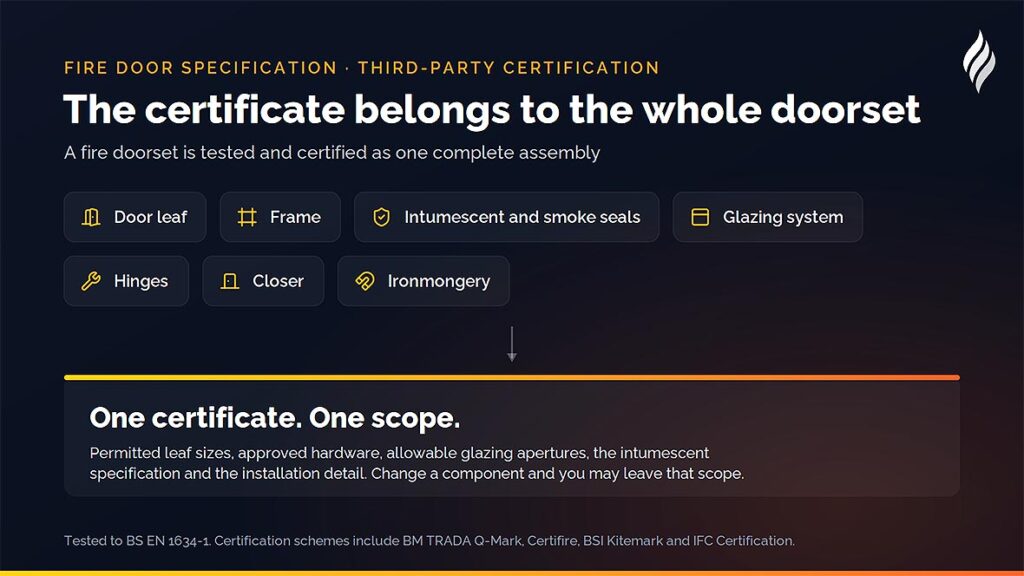
A fire door is not a product. It is an assembly: the leaf, the frame, the intumescent and smoke seals, the glazing system, the hinges, the closer and the rest of the ironmongery, fitted together in a specific way. When a doorset passes a fire resistance test to BS EN 1634-1, it is that complete assembly, in that configuration, which earns the result. The test evidence, and any third-party certification built on it, describes a scope: permitted leaf sizes, approved hardware, allowable glazing apertures, the intumescent specification, the installation detail.
Third-party certification schemes such as BM TRADA Q-Mark, Certifire, the BSI Kitemark and IFC Certification add ongoing factory audits and traceability to that test evidence. Certification is not in itself a legal requirement, but it is the strongest practical assurance a specifier can buy, and it is what fire and rescue services, insurers and building control increasingly expect to see. After Grenfell, the government told local authorities and housing associations to replace suspect flat entrance doors with doorsets that were third-party certified. There was a reason for the emphasis. Government testing in 2018 found doors from five separate suppliers failing the 30 minute standard they were sold against, and the investigation began when the flat entrance door recovered from Grenfell Tower, designed to resist fire for 30 minutes, failed at roughly 15. Paper and performance are not the same thing, and certification is how the industry ties them together.
For the specifier, the practical rule is short: specify the certificated doorset, not a door leaf plus a shopping list of parts. Name the certificate, and make its scope part of the specification.
Most certification is not broken by anyone acting badly. It is broken in ordinary meetings, by ordinary decisions that look harmless.
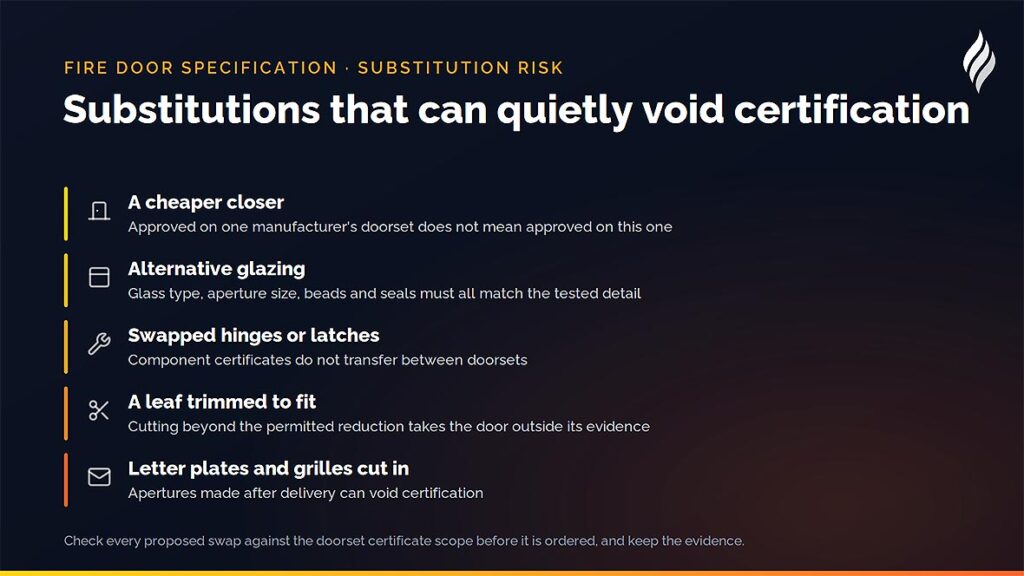
Value engineering is the usual route. A cheaper closer, an alternative glass, a different hinge from a supplier with stock. Each swap seems trivial, because each component is often certified in its own right. But component certificates do not transfer: a closer approved on one manufacturer’s doorset is not automatically approved on another’s, and a certificate cannot be read across from one product to the next. The doorset certificate is the governing document, and if a fitted component sits outside its scope, the assembly on the wall no longer has evidence behind it.
Site decisions do the same work more quietly. A leaf trimmed beyond the permitted reduction to suit an opening. A letter plate or air transfer grille cut in after delivery. Glazing beads refixed with the wrong detail. None of these look like fire safety decisions at the time, and every one of them can take a compliant doorset outside its evidence.
Two lines in the specification close most of this down. First, that any proposed substitution must be shown to fall within the doorset certificate’s scope before it is ordered, with the evidence kept. Second, that the installer records what was actually fitted to each opening, so the as-built record matches the wall rather than the order book.
There is now a hard date underneath all of this. The government confirmed in September 2024 that the national classes, the BS 476 series, are being withdrawn from Approved Document B in favour of the European classification system. References to the reaction to fire tests went in March 2025. Fire resistance, which covers fire doorsets, has a coexistence period that ends on 2 September 2029, after which BS EN 13501 classifications, based on testing to BS EN 1634-1, become the sole route in the statutory guidance for new work in England.
A doorset specified today on legacy BS 476-22 evidence alone will spend most of its service life resting on withdrawn paperwork. For new work the direction is clear: ask for BS EN 1634-1 test evidence and a BS EN 13501-2 classification now, and treat legacy-only evidence as a question to raise with the manufacturer rather than a box ticked. It is also worth knowing that BS 8214, the code of practice for fire door assemblies, was revised in March 2026 with a scope that now reaches beyond timber; installation to the current code belongs in the specification too.
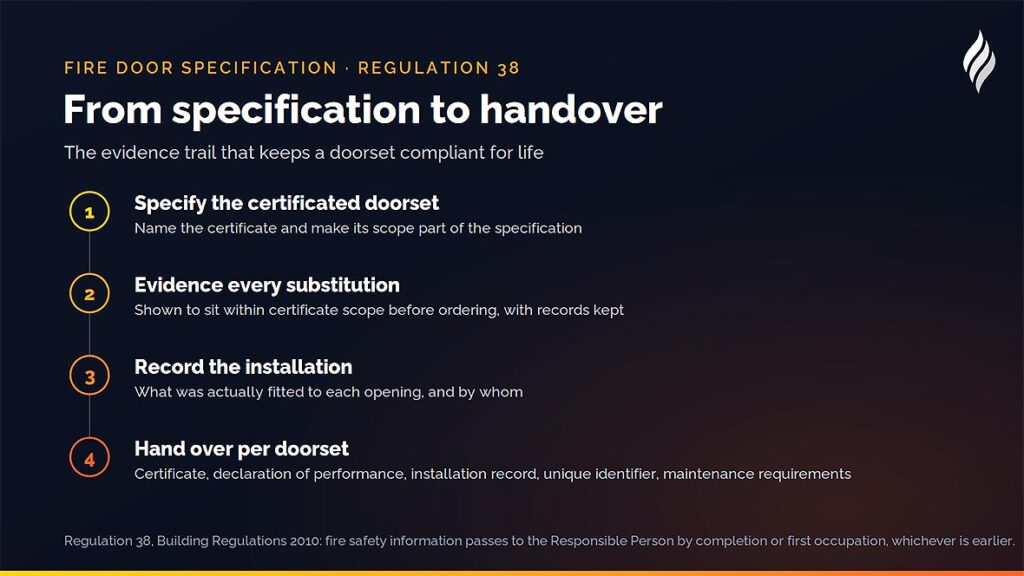
A compliant doorset with no paperwork becomes, at handover, a door someone must now prove. Regulation 38 of the Building Regulations exists for exactly this: the person carrying out the work must give the fire safety information to the Responsible Person no later than completion or first occupation, whichever comes first, and the Responsible Person acknowledges receipt. For higher-risk buildings under the Building Safety Act 2022, the same information starts the golden thread, which must be kept accurate, digital and accessible for the life of the building.
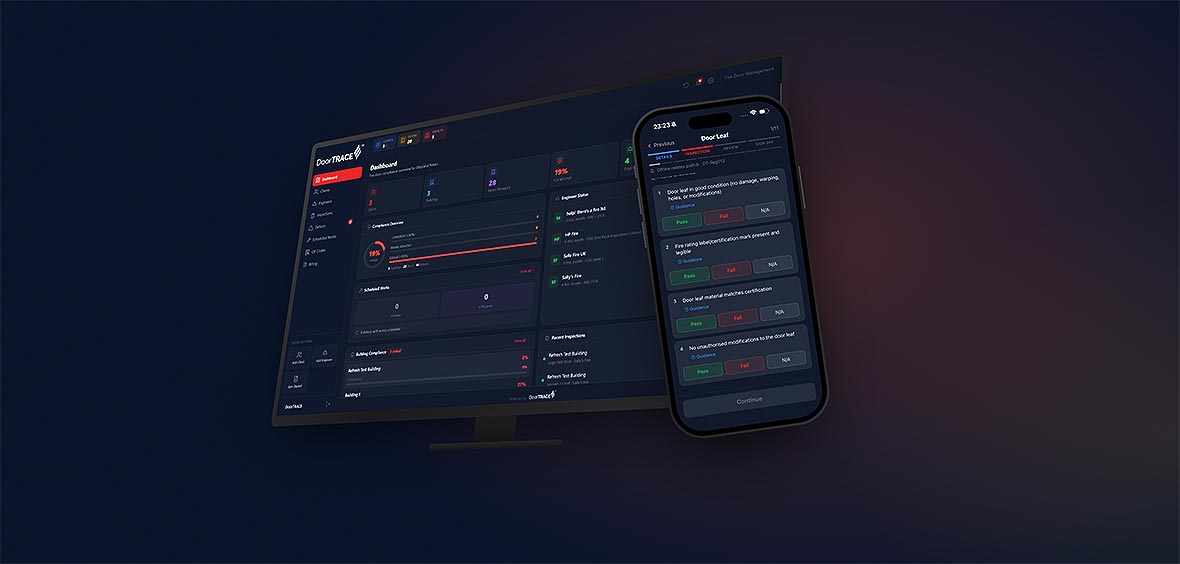
For fire doors, a handover pack worth the name is organised per doorset, not per project: the certificate and its scope, the declaration of performance where one exists, the installation record showing what was fitted and by whom, a unique identifier for the opening, and the maintenance the manufacturer requires. Across the portfolios we see on DoorTRACE, the doors that cost the most are rarely the ones with defects; they are the ones with no traceable evidence, where every inspection starts from scratch and every fire risk assessment inherits the gap.
The test of a good specification is not the day the building opens. It is year seven, when the closer needs replacing and the person ordering the part can find, in minutes, exactly what the certificate allows.
Kemble Nagan is Managing Director of DoorTRACE, a UK platform for fire door inspection, compliance and golden thread record keeping. www.doortrace.co.uk
This article is general guidance on UK fire safety requirements and is not legal advice.